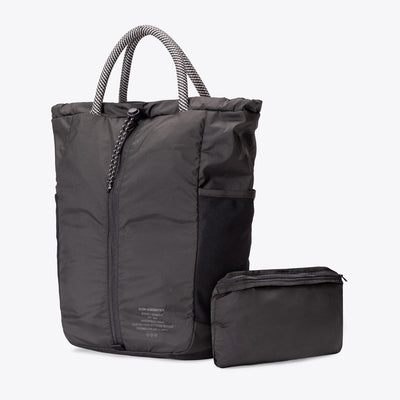
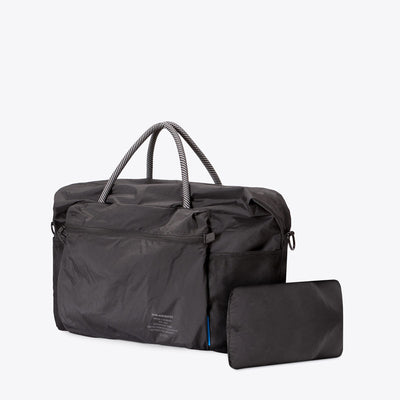
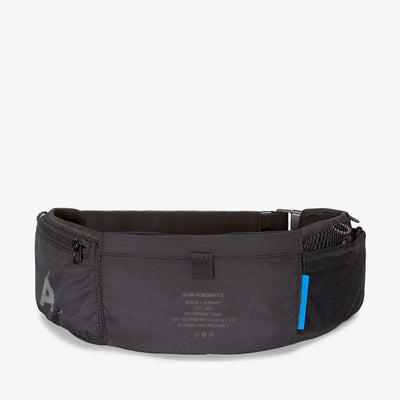
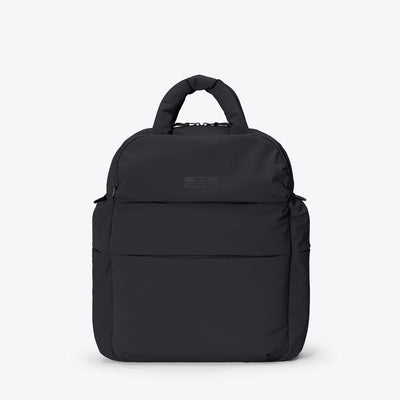

A backpack spends surprisingly little time sitting neatly on a shelf. It slides under café tables, brushes against walls, gets squeezed onto trains, and lands beside your desk. Its surface meets the city long before you reach your destination.
For our Lotus Infinity Series, that everyday contact became a material challenge. We wanted a surface that could withstand repeated use while preserving the clean appearance and soft feel that define the series. None of the materials available on the market met all of our requirements. So we decided to develop our own.
The result was PUrTEX∞. Getting there took over two years.
The part you touch every day
When choosing a backpack, you probably notice its shape, color, and size first. You picture what fits inside it. You try it on. The material can be easier to overlook. Yet it influences how the bag feels in your hand, how it folds, and how its surface responds to daily use.
Think about a roll-top: every opening and closing asks the material to bend again. Other parts of a backpack need to do the opposite: they must remain firm enough to give the bag structure. At the same time, areas such as the bottom corners repeatedly rub against floors, walls, and other surfaces. These small encounters add up.
For Lotus Infinity, we focused on abrasion resistance, strength, and flexibility, alongside reducing unnecessary material and designing with future recycling in mind. Meeting these different demands led us to develop two versions of the same material.
Knife Test
Wall Abrasion Test
Waterproof Test
Pavement Abrasion Test
One material, two different jobs
The challenge was not simply to make a PU surface tougher. We wanted to reduce the amount of PU, replace the bottle-based polyester backing with recycled textile waste, and eliminate solvents such as DMF and VOC-based adhesives.
At the same time, different parts of a backpack require different material properties. We therefore developed two versions of PUrTEX∞.
The first is flexible enough to bend comfortably with every opening and closing of a roll-top. The second is considerably more rigid and provides structure without requiring an additional layer of PE foam.
Developing both versions meant balancing properties that do not automatically go together: flexibility and stability, softness and abrasion resistance, reduced material use and long-term performance. Achieving those different characteristics while preserving the same clean appearance required us to develop and test the construction over and over again in different scenarios.
Development happened at the factory
Developing PUrTEX∞ was not something we could manage through specifications and sample shipments alone. During the development process, our co-founder Martin visited our material manufacturing partner in China twice to work directly with the people responsible for the material.
Being there allowed us to examine the different versions together, discuss how each layer contributed to the material’s behavior, and translate the requirements of a backpack into technical decisions. A roll-top needed flexibility, while structural parts required firmness. At the same time, both versions had to share the same appearance and meet our expectations for everyday use.
These visits helped turn an initial material concept into something that could work in an actual product. The process was not about finding an existing material in a catalogue. It was about developing the right construction together.


What PUrTEX∞ is made of
PUrTEX∞ combines an interlock textile backing made from recycled polyester derived from textile waste with a multi-layer polyurethane surface. Two thin PU film layers create the texture, color, and protective finish, while a PU foam layer contributes to the material’s soft feel.
By adapting the internal construction, we created a flexible version for areas that need to move and a firmer version for areas that require stability - without adding a separate thick layer of PE foam.
By developing a more stable internal structure, we were able to reduce the amount of PU by 30% compared with our previous material. This construction allows the individual layers to perform different tasks: the backing provides strength and stability, while the PU surface protects the material and creates its characteristic appearance and feel.

Giving textile waste another use
Our initial Lotus products used recycled polyester made from PET bottles. At the time, this was the established route for recycled polyester.
For Lotus Infinity, we wanted to take responsibility for waste from our own industry instead. Rather than using plastic bottles from the beverage industry, the backing of PUrTEX∞ is made with polyester recovered from textile waste. Recycled polyester derived from textile waste is also used across many of the backpack’s other textile components. Suitable textile waste is processed into recycled PET and spun into new polyester yarn. That yarn becomes the knitted foundation beneath the PU layers.
It is important to be precise here. A backing made entirely from recycled textile waste does not mean that the complete coated material - or the finished backpack - is made entirely from recycled textiles. The PU surface and the other components of a backpack have their own material compositions.
Material innovation begins with understanding those individual parts and being transparent about what each one contributes.
Using less material and fewer chemicals
Material efficiency was only one part of the development. We also examined the chemistry and construction behind the material.
PUrTEX∞ is produced without solvents such as DMF and without adhesives containing volatile organic compounds. These choices formed part of a broader effort to reduce unnecessary material and limit the use of certain chemicals without compromising the qualities required for everyday use.
The environmental impact of a material depends on its complete manufacturing process. No single change can describe the footprint of a finished backpack, which also includes many other materials, components, and production steps.
Designed for repeated stuff
Abrasion resistance can sound like a laboratory term. In everyday life, it simply describes how well a material handles rubbing, scraping, and repeated contact.
Throughout the development process, we tested PUrTEX∞ against the different stresses a backpack encounters. These include pulling, tearing, repeated folding, surface friction, and the forces acting between its individual layers.
The tests helped us refine the material’s construction and balance flexibility, structural stability, and surface resistance. For a roll-top design such as Hajo, the purpose is practical: the material needs to move comfortably when the bag is opened and closed while withstanding the repeated contact of daily use.
Laboratory tests remain indicators rather than a prediction of how many years a backpack will last. Its actual lifespan also depends on the construction of the complete product, how it is used, and whether individual components can be repaired or replaced.
Two years behind an everyday object
We spent over two years developing PUrTEX∞ for moments as ordinary as your morning commute. Every time you roll the top, set your bag down, or squeeze onto a crowded train, the material has a job to do.
With Lotus Infinity, we put that work into the part of the bag you touch, fold, and carry every day. The finished design stays simple. What went into it is anything but.
