
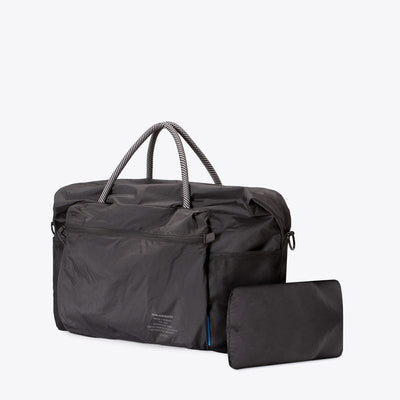
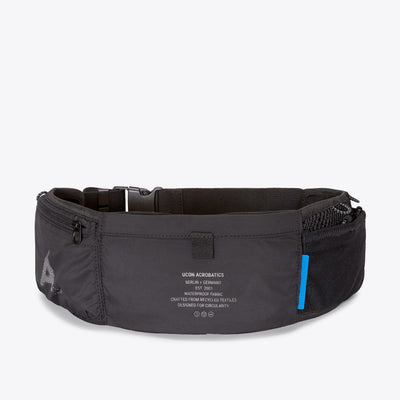
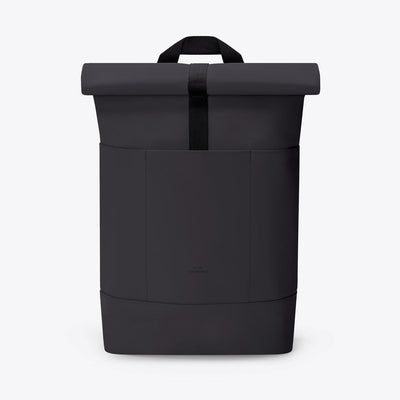

“Made from recycled materials” appears on countless labels – but it can mean very different things depending on what is actually behind the claim. We have talked about our commitment to textile recycling before, but we have never really explained in detail what happens between “old fabric” and “new backpack”. So here is a closer look – including the partner that makes one of our three recycling methods possible in the first place: Jiaren (Zhejiang Jiaren New Materials Co., Ltd.), our long-standing partner for chemical textile-to-textile recycling in China.
Why we moved beyond bottle recycling
Since 2017, we have used recycled polyester made from PET bottles. It is an established technology, and costs have fallen over the years to the point where even the food industry now competes for the same material. Today, around 98% of recycled polyester worldwide still comes from bottles rather than textiles.
The problem: bottle-to-fiber is usually not a closed loop. A PET bottle can be turned into a textile fiber, but with mechanical recycling, the quality of the polymer gradually declines over subsequent recycling cycles. At the same time, turning bottles into fibers removes them from an already established bottle-to-bottle recycling loop – while leaving the textile industry’s own waste problem unresolved. According to Textile Exchange’s Materials Market Report 2025, less than 1% of the global fiber market still comes from recycled textiles. Most of the “recycled polyester” found on labels across the industry remains bottle-based rather than textile-based.

That is exactly the gap we want to close: turning textile waste back into textiles instead of borrowing plastic from another industry. We began transitioning our production in 2023, completed the changeover in mid-2024, and since the beginning of 2025, every new product we launch has been based on textile-to-textile recycling rather than bottle-based recycled polyester.

Three recycling methods,
three different purposes
Today, we use three different recycling approaches – depending on the type of waste stream we are working with and which part of a bag or backpack the resulting material is intended for.
Fiber-to-filler
→ DOWNCYLING
Industrial textile waste made from blended materials – for example, cutting scraps containing both polyester and cotton – can hardly be separated cleanly into pure materials with today’s technology. Instead of sending it to landfill or incineration, we shred it into fibers and felt them into rigid and soft felt sheets.
These replace the PP sheets (polypropylene) and PE foam (polyethylene) still commonly used in bags to provide structure and padding. You never actually see this material – it sits inside the parts that give a bag its shape and softness – but it is one of the more hidden changes we have implemented across the collection.
Fiber-to-fiber
→ MECHANICAL RECYCLING
Where the waste stream is cleaner – meaning it is already close to a mono-material – it can be mechanically recycled: shredded, melted and extruded directly into new yarn.
This process is more energy-efficient than the chemical route described below, but it only works where material purity is already high, as blended fibers cannot be separated through mechanical recycling.
Fiber-to-fiber
→ CHEMICAL RECYCLING
This is the method with the greatest potential – and the most complex process. Textile waste with a polyester content of at least 90% undergoes chemical depolymerization. The polymer is broken down under pressure and heat into its molecular building blocks, purified and then polymerized back into new PET.
The result is recycled PET granulate with a quality that is virtually indistinguishable from virgin material – because at the molecular level, it is equivalent polyester, only made from waste rather than petroleum.
This is where Jiaren comes in. Its facility uses a monomer-level depolymerization process based on DMT chemistry rather than mechanical reprocessing. The process is specifically designed to handle low-value, mixed textile waste – exactly the kind of material that otherwise has little economic use.

Why molecular recycling changes the question of quality
Because the process selectively recovers PET at the molecular level while removing other components, incoming material inspections focus primarily on moisture and polyester content. Chemical safety is then ensured through the recycling process itself, as well as through controls on the chemicals used and the resulting outputs.
Jiaren follows the OEKO-TEX Eco Passport framework during feedstock pre-processing and participates in the ZDHC Recycled Polyester Module. According to the company, more than 95% of the chemicals and solvents used in the process are recovered.

Traceability that does not look like a percentage on a label
With monomer-level chemical recycling, the nature of traceability changes. Before recycling, the incoming waste streams are documented according to origin, material composition and pre- or post-consumer classification. Jiaren currently works with seven approved feedstock suppliers and, since December 2025, has additionally recorded incoming recycled materials through Textile Exchange’s Reclaimed Material Declaration Forms (RMDFs).
During the recycling process itself, however, this distinction loses its physical meaning. The polyester is broken down into its molecular building blocks, purified and then rebuilt. In the finished material, it is therefore no longer possible to distinguish which molecule originally came from, for example, used workwear and which came from an industrial cutting scrap. According to Jiaren, the technical properties of the finished material also do not differ depending on whether the original feedstock came from pre- or post-consumer waste. For this reason, Jiaren considers mass balance accounting more meaningful for monomer-based chemical recycling than assigning batch-level PCR/PIR labels to the finished material. At the same time, the incoming waste streams remain documented before entering the recycling process. Through the RMDF, Textile Exchange requires information including material composition, feedstock type and pre-/post-consumer classification. Information on the specific origin of individual waste streams is currently optional and often difficult to verify consistently. This makes it possible to document what enters the recycling process, even though these different sources can no longer be physically distinguished after depolymerization.
Jiaren is currently certified to the Textile Exchange's Recycled Claim Standard (RCS) and participated in the pilot audit for the new Textile Exchange's Materials Matter Standard (MMS) in January 2026. Formal certification under the new standard is planned for 2027.
What this looks like in an actual product
To make this less abstract, take the Hajo Mini Backpack from our Original Series. With a total weight of 880 g, 88% of the entire product – including production waste – consists of recycled textile material. Looking at the textile components alone, that figure rises to 97%.
The overall material composition is 90% rPET polyester made from recycled textiles, 4% iron for hardware and zippers, and 6% other materials. Of the recycled content, 58% comes from post-consumer textile waste and 30% from pre-consumer textile waste. Broken down by recycling method, 58% comes from chemical recycling – our fiber-to-fiber process with Jiaren – 21% from mechanical recycling and 9% from downcycling through our fiber-to-filler process.
The product’s environmental footprint is 2.82 kg CO₂e, 36.5 MJ of energy consumption and 0.70 m³ of water consumption. We publish these figures directly with the product because the word “recycled” alone says very little about how much of a product is actually made from recycled material – or where that material comes from.

Where the raw material comes from
The feedstock for our chemical recycling stream comes from a mixture of post-consumer and post-industrial textile waste sourced within China to avoid the emissions associated with transporting unprocessed textile waste internationally. Post-consumer feedstock includes, for example, collected school uniforms, corporate workwear, train and airline seat textiles, plush toys, as well as sorted textiles from waste collectors.
Our recycling partner documents incoming feedstock through Textile Exchange’s Reclaimed Material Declaration Forms (RMDF), including material composition and pre- and post-consumer classification. The recycler is RCS certified, all recycled material volumes are reconciled, and there is no parallel stream of non-certified material within the facility. As textile traceability standards continue to evolve, we expect this level of transparency to improve further.
In total, our company sourced 75.000 kg of recycled textiles from our suppliers during the first two years. The breakdown was 80% chemical recycling, 16% mechanical recycling, and 4% downcycling.
The honest limitations
We do not pretend that the problem has been completely solved. Chemical recycling still requires a relatively high level of polyester purity in the feedstock and consumes more energy than mechanical recycling – around 20 MJ per kilogram of recycled PET granulate compared with approximately 72 MJ for virgin material, according to Intertech data, which still represents a significant improvement.
Industry-wide standards for labeling and traceability also continue to lag behind the technology itself. And there is still no comprehensive, household-level take-back infrastructure for textiles. That is why we currently do not encourage customers to send old products back to us: as long as this infrastructure is missing, the additional transport emissions would outweigh the benefits.
Why we share this much detail
We would rather explain the mechanics behind it – including the parts that are not yet perfectly solved – than reduce all of this complexity to a single word on a label.
Recycling continues to evolve: technologies improve, standards change, and we keep learning too. That is why we will continue to update this article whenever processes, data or new findings change.