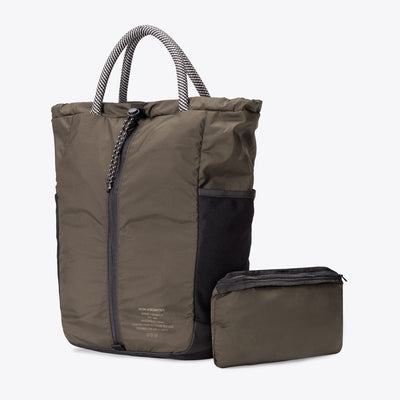
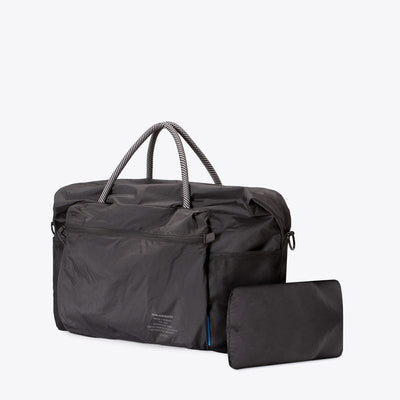
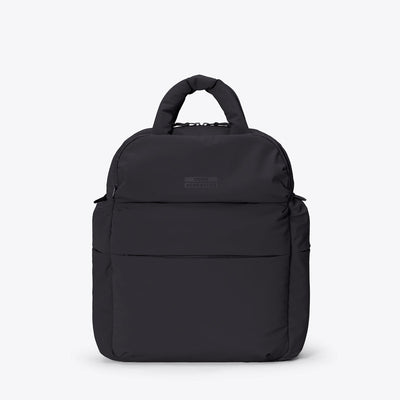
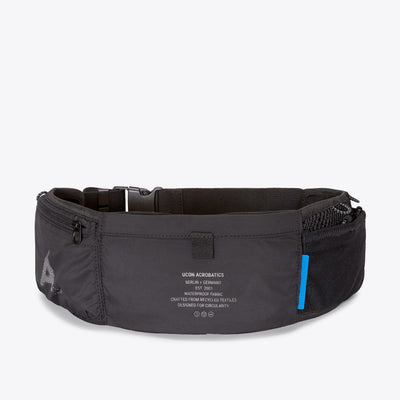

Climate commitments are easy to make in broad terms. The more difficult work begins when a product is taken apart, material by material, and its impact is traced back through the supply chain.
We do not describe Ucon Acrobatics as carbon neutral. Instead, we are building the data needed to understand where the environmental impact of our products comes from and how material and design decisions can reduce it.
Around 70% of the fashion industry's CO₂ emissions occur upstream - during raw material production, preparation and processing. That's why our climate work starts with the product itself. Our current measurement begins at product level. This is where we can connect environmental data directly to the decisions made during product development.
Starting With Every Material
A backpack may appear to be one product, but it is made from many individual components. The outer fabric, lining, straps, padding, zippers and coatings each have their own origin and production process.
To understand this more clearly, we have developed detailed ‘Bills of Materials’ for our best-selling products. A ‘Bill of Materials’ records the individual components used to make a product and the materials from which they are made.

This information is connected to our material database, which tracks where materials come from, how recycled materials have been processed and key environmental indicators associated with them. These indicators include CO₂ emissions, water consumption and energy use.
Together, these systems give us an increasingly detailed picture of the material-related impact of individual products. They also allow environmental information to become part of product development rather than something calculated only after a product has already been designed.
Turning Data Into Design Decisions
Measurement is only useful when it changes what happens next. Product-level data helps us examine where the greatest impacts occur and where a different material or construction could make a meaningful difference. This has contributed to decisions such as replacing recycled PET bottles with recycled textile waste, increasing mono-material content and using dope-dyed materials with significantly lower water and energy requirements.
This means looking not only at how much recycled material a product contains, but also at where that material came from, how it was recycled and whether the finished product can become a useful material source again in the future.
The aim is to build environmental considerations into the product from the beginning. Material selection, product construction and recyclability are treated as connected decisions rather than separate sustainability initiatives.

Making Product Data Visible
The information collected through our ‘Bills of Materials’ and material database is also communicated to customers through stickers on our product packaging.
These stickers make selected environmental indicators visible at the point of purchase. They connect material and product information to the physical bag rather than leaving it in a separate corporate report. This information will also be available on our website soon.
Not every product in our collection is covered to the same level of detail yet. We began with our best-selling items and are continuing to expand the system.
Reducing the Need to Fly
Materials are only one part of a product’s environmental impact. How products travel also matters. For production shipments from our manufacturing partners in Asia to our European warehouse, we prioritize sea freight. Air freight is limited to samples and exceptional situations, accounting for less than 1% of the products we transport annually.
Keeping air freight below 1% requires production planning and the consolidation of shipments. It is a practical reduction measure that prevents emissions before they occur, rather than trying to compensate for them afterward.
Why We Do Not Use Carbon Offsets
We do not currently use carbon offsets to describe our company or products as carbon neutral. Our priority is to improve the data behind our products and use it to reduce their impact through materials, design and transport decisions. Offsetting cannot replace this work. It does not show which parts of a product have the greatest impact or help a designer decide what should change in the next version.
For us, the more important question is not how to balance an estimated impact elsewhere, but how to reduce that impact within the product and its supply chain.
What We Do Not Yet Measure Company-Wide
Our most detailed environmental data currently exists at product and material level. We do not currently publish a company-wide greenhouse gas inventory covering the full business.
This means we are not presenting a company-wide emissions total, base year or corporate reduction percentage. Our current product-level system should not be confused with a complete greenhouse gas inventory for every part of our operations and value chain.
This remains an important gap in our public climate reporting. Expanding our Bills of Materials across the full collection, improving the quality of the underlying data and broadening the measurement boundary will give us a more complete picture over time.
Our next task is not to create a bigger claim. It is to make the measurement system bigger, more accurate and more useful.
Because meaningful climate work begins with knowing what to change.