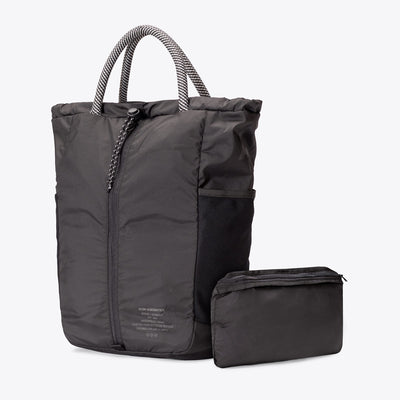
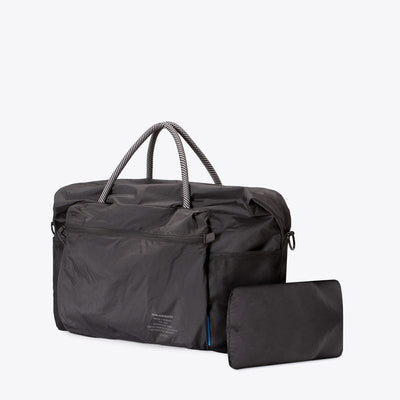
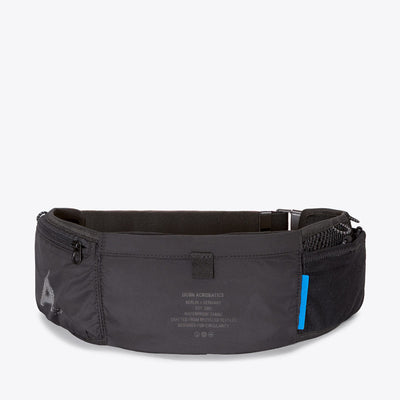
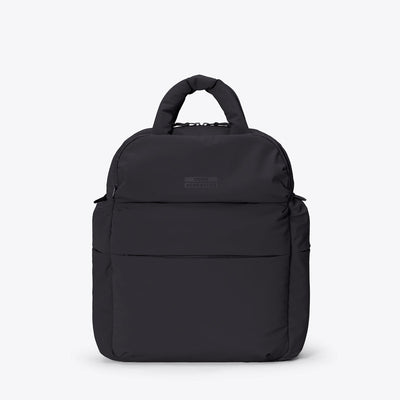

Making a bag from recycled textiles is only part of the story. The harder question is whether the finished product can remain in use longer, be repaired, and eventually become material for something new.
The end of a bag’s life rarely arrives at a clearly defined moment. A zipper may fail while the fabric remains intact. A buckle may break after years of use. Or the bag may simply no longer fit the life of its owner, even though it can still be carried.
For brands, this creates an uncomfortable question. It is relatively easy to describe what a product is made from when it is new. It is much harder to explain what will happen to the complete product years later.
At Ucon Acrobatics, we do not yet have a perfect answer. The recycling infrastructure required to collect, separate, and recover the different materials in a finished bag is still largely unavailable. Our current approach therefore starts with the step that is possible now: keeping each bag in use for as long as possible, while redesigning its materials for a more circular future.

The First End-of-Life Strategy Is a Longer Life
A product that lasts does not need to be replaced as quickly. That is why durability is not separate from circular design. It is the first part of it.
We design our bags around durable materials, everyday functionality, and forms that are intended to remain relevant beyond a single season. Material performance matters here because a recycled input has little value if the finished product wears out too soon.
The development of Lotus Infinity illustrates this approach. We reworked our original Lotus material into a custom-developed polyurethane material made with recycled textiles. Compared with the previous material, Lotus Infinity offers higher tear strength, stronger layer adhesion, and higher abrasion resistance. These figures describe specific laboratory performance improvements. Their practical purpose is simple: to help the material withstand more of the repeated friction, pulling, and movement that come with daily use.
The best thing we can do today is keep a bag in use for as long as possible,” says Martin Fussenegger, co-founder of Ucon Acrobatics. “But longevity alone isn't enough. At the same time, we have to redesign products for what happens afterward.”
Recycled Is Not the Same as Recyclable
Since 2025, all newly developed Ucon Acrobatics collections have been based on textile-to-textile recycled polyester rather than polyester made from recycled PET bottles. In the Original Series, for example, up to 96% of the textile components are made from recycled textile waste.
That distinction matters. Bottle-to-textile recycling gives plastic packaging a second use, but the material usually does not return to the textile system afterward. Textile-to-textile recycling begins with textile waste and turns it back into material for new textiles. It brings the input closer to the loop we ultimately want to create.
However, using recycled textiles does not mean that a finished bag can automatically be recycled as a whole. A backpack is a complex product. Its shell, lining, coating, thread, reinforcement, padding, zippers, buckles, and metal parts may require different processing methods. Even when individual components are recyclable, separating them efficiently can be difficult or economically unviable.
This is why we distinguish between designing with recycled materials and ensuring that a complete product will be recycled. We can influence the first today. The second also depends on collection, sorting, disassembly, and recycling systems that do not yet operate at the necessary scale.
Different Waste Requires Different Routes
There is no single recycling process suited to every kind of textile waste. Depending on the composition and condition of the material, we work with three different approaches.
Chemical fiber-to-fiber recycling can break polyester down and use it to produce new fibers. Mechanical fiber-to-fiber recycling processes suitable textile waste without chemically dissolving it. When mixed textile waste cannot be returned to a high-quality fiber, fiber-to-filler recycling can still recover it for use as filling material.
These routes do not produce identical results, and they should not be presented as though they do. Fiber-to-fiber recycling has the greatest potential to keep material within textile production. Fiber-to-filler recycling is a lower-value application, but it can still prevent suitable waste from being discarded immediately. The route depends on what the material can realistically become next.
Moving Toward Simpler Material Systems
One of the most important design questions is not only how much recycled material a bag contains, but how many different materials must be separated at the end.
A mono-material product, made primarily from one compatible material family, can be easier to recycle than a product built from many bonded layers and mixed components. Bags still have demanding performance requirements, so eliminating every material difference is not yet realistic. Coatings must protect against weather, padding must absorb impact, and closures must withstand repeated use.
Our work is therefore focused on reducing unnecessary material complexity and redesigning components around compatible material families. In selected products, up to 96% of the total product weight already consists of recycled polyester made from textile waste. This does not make the product fully mono-material or guarantee that it will be recycled. But it brings us significantly closer to products designed for future textile-to-textile recycling.
What Needs to Happen Next
Our ambition is to support industry-wide collection and recycling systems that can handle complex textile products at scale. Shared infrastructure matters because end-of-life systems cannot be built effectively by one brand alone. They require cooperation among manufacturers, recyclers, collection networks, policymakers, and other companies using the same material streams.
Until those systems are in place, our priorities remain concrete: improve durability, make selected replacement parts available, increase the share of textile-to-textile recycled inputs, simplify material combinations where performance allows, and communicate the limitations as clearly as the progress.
We won't call a bag circular before the system exists. Until then, our job is to make every generation more durable, use better material systems and design products that are better prepared for what comes next. Because the end of a product should eventually become the beginning of another.